
There's an irony to Aerodrome's native token. Aerodrome is Base's largest DEX — the protocol that processes more swap volume than any other on the network. And yet AERO holders who sell large positions through the very pools their token trades on are losing significant value to price impact. Not because Aerodrome is broken, but because AMM mechanics penalise large orders in thin pools regardless of which protocol runs them.
We wanted to know exactly how much. So we pulled every AERO swap on Base — 23.9 million of them — and measured it.
The Scale of the Problem
AERO trades across multiple DEXs on Base, but pool depth has been declining. As liquidity thins, the constant-product AMM formula punishes each additional dollar of order size more severely. A swap that consumes 50% or more of a pool's depth doesn't just move the price — it destroys the execution. And with AERO, we see swaps routinely consuming 60%, 70%, even 85% of available liquidity in a single transaction.
The Data
We scanned 23,932,916 raw AERO swaps across four DEXs on Base: Uniswap V3, Aerodrome, PancakeSwap V3, and SushiSwap V3. Before running any analysis, we applied filters to remove bot activity, MEV sandwich attacks, and dust trades:
| Filter | Removed | Reason |
|---|---|---|
| F1: Dust (<$1,000) | 22,649,355 | Arb remnants, failed tx dust |
| F4: High-frequency (≥3/hr) | 1,056,891 | Automated bot activity |
| F6: Sandwich pairs | 5,912 | MEV front/back-runs |
| F7: Round-trip arb | 88,690 | Multi-hop circular arb |
| F8: Repeated identical amounts | 15,136 | Bot fingerprints |
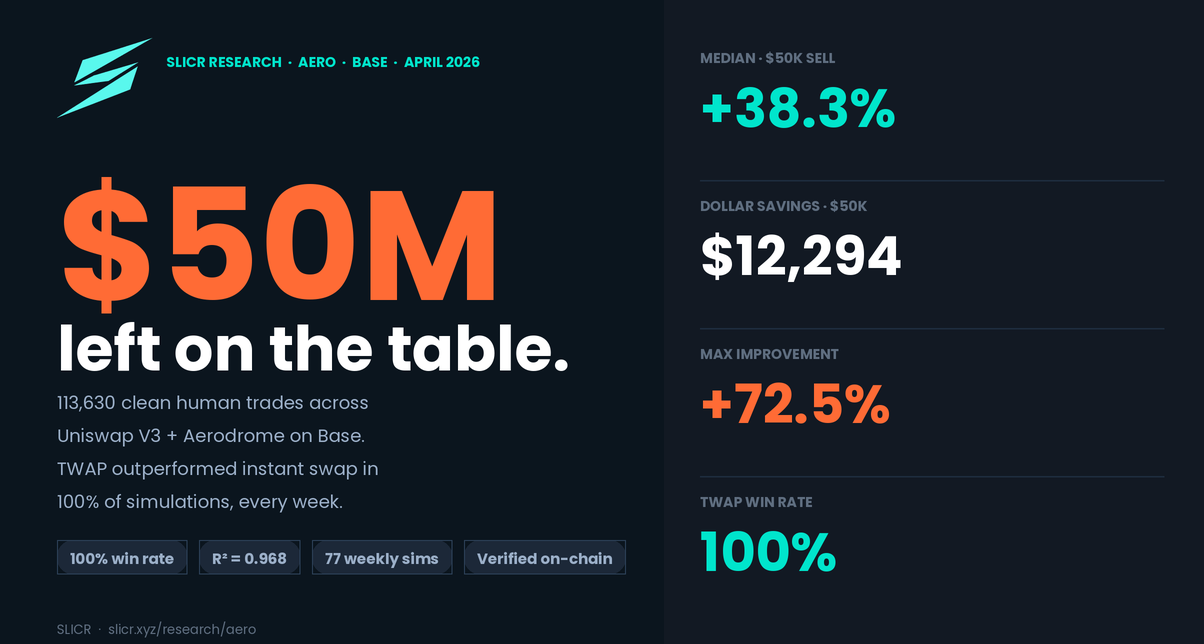
Clean swaps retained: 113,630. Filter rate: 99.5%, driven heavily by PancakeSwap arbitrage dust.
The 99.5% filter rate is extreme but expected — PancakeSwap V3 generates enormous volumes of sub-$1 arbitrage remnants. The 113,630 swaps that survived represent genuine human trading decisions.
What We Found
The core result — Uniswap V3, 24h TWAP
We simulated what a Slicr TWAP would have returned versus an instant swap across five order sizes. The results are medians — central tendency across market conditions, not cherry-picked best cases.
| Order Size | Instant Output | TWAP 24h Output | Improvement |
|---|---|---|---|
| $5,000 | $4,744 | $4,930 | +3.9% (+$186) |
| $10,000 | $9,026 | $9,751 | +8.0% (+$724) |
| $25,000 | $19,690 | $23,598 | +19.8% (+$3,908) |
| $50,000 | $32,481 | $44,926 | +38.3% (+$12,444) |
| $100,000 | $48,107 | $83,000 | +72.5% (+$34,893) |
Median values, Uniswap V3 AERO/WETH, 24h TWAP, 10 slices, 30 bps fee deducted.
TWAP won 100% of the time
TWAP outperformed instant swap in every single simulation for orders above $5K. This isn't a strategy that works "most of the time" — the improvement is structural. AMM price impact is deterministic given pool depth, and TWAP's slice-and-wait approach allows arbitrage bots to restore the pool price between each slice.
Bigger order = more TWAP helps
The relationship between order size and TWAP benefit is convex, not linear. A $5K AERO sell sees +3.9% improvement. Scale that to $100K and the improvement explodes to +72.5%. The AMM's constant-product formula penalises each additional dollar of order size more than the last — and TWAP neutralises this by keeping each slice small relative to the pool.
Duration comparison
Longer TWAP durations give the pool more time to recover between slices, but the marginal gains diminish:
| Duration | $25K Improvement | $50K Improvement |
|---|---|---|
| 4 hours | +18.7% | +36.2% |
| 12 hours | +18.9% | +36.6% |
| 24 hours | +19.8% | +38.3% |
Even a 4-hour TWAP captures most of the benefit. Going from 4h to 24h adds only ~1 percentage point for $25K and ~2 points for $50K. For sellers concerned about directional exposure, a shorter duration is a reasonable trade-off.
Best single case
December 28, 2024
$100,000 AERO sell
Instant output
$37,083
TWAP 24h output
$78,615
+$41,532 (+112.0%)
Pool depth: ~$117,879. The order consumed 84.8% of the pool in a single transaction.
Aerodrome vs Uniswap V3
We compared TWAP performance across both major AERO venues:
| Order Size | Uniswap V3 (24h) | Aerodrome (24h) |
|---|---|---|
| $10K | +8.0% (+$724) | +6.7% (+$611) |
| $25K | +19.8% (+$3,908) | +16.6% (+$3,389) |
| $50K | +38.3% (+$12,444) | +32.2% (+$11,131) |
| $100K | +72.5% (+$34,893) | +61.0% (+$32,149) |
Uniswap V3 shows slightly higher TWAP improvements across all order sizes. This is because the Uniswap V3 AERO/WETH pool tends to be shallower, meaning each slice has proportionally more impact to recover from. Slicr's multi-DEX router routes each slice to the best available price automatically — including whichever pool is deeper at the moment of execution.
Liquidity is declining
AERO pool depth has been trending down. As early LPs withdraw and fee revenue declines, the remaining market gets thinner. The consequence: the TWAP advantage is growing over time. Sellers who could have tolerated instant execution a year ago now face materially worse outcomes at the same order size.
The fee question
Slicr charges 30 basis points on tokenOut. For a $50,000 AERO sell, that's $150. The median TWAP improvement at that order size is $12,444. That's an 83:1 fee-to-benefit ratio. You pay $1 in fees for every $83 in execution improvement.
The Whales: 15 Wallets, $4.5M Left on the Table
We identified 15 wallets that executed large AERO sells with significant price impact. Together, they represent 61 transactions totalling $11.8M in order volume. They received $6.1M. TWAP simulations show they could have received $10.6M — a difference of $4,477,790 (+73.4%).
| Wallet | Txns | Volume | Received | TWAP Est. | Savings |
|---|---|---|---|---|---|
| 0xb0eb…a2a | 2 | $984,410 | $331,577 | $804,292 | +$472,716 (+142.6%) |
| 0xca74…a3d | 8 | $1,146,102 | $707,480 | $1,073,497 | +$366,017 (+51.7%) |
| 0x8524…b9e | 10 | $1,136,422 | $708,741 | $1,065,976 | +$357,236 (+50.4%) |
| 0x76bd…038 | 4 | $873,142 | $422,484 | $778,995 | +$356,511 (+84.4%) |
| 0xaf3e…238 | 2 | $645,419 | $281,704 | $567,282 | +$285,579 (+101.4%) |
| All 15 wallets | 61 | $11,807,796 | $6,104,087 | $10,581,877 | +$4,477,790 (+73.4%) |
Case A: 0xb0eb...a2a — $472K in avoidable losses
This wallet sold $984,410 of AERO in just 2 transactions on the same day — June 2, 2024. They received $331,577: 33 cents on the dollar. Each swap consumed approximately 66% of a ~$500K pool instantly, cratering the price before the second transaction could execute at anything close to fair value. A 24h TWAP simulation returns $804,292 — a saving of $472,716 (+142.6%).
Case B: 0xaf3e...238 — Two swaps, 60 seconds apart
On December 20, 2024, this wallet executed $645,419 of AERO sells in 2 transactions separated by just 60 seconds. They received $281,704 — 43.6% of the order value. The second swap hit an already-depleted pool, compounding the damage. A 24h TWAP simulation returns $567,282 — a saving of $285,579 (+101.4%). More than doubling their output.
Caveats
The AMM model used is constant-product (V2 formula), which slightly overstates impact for Uniswap V3 concentrated liquidity — meaning our TWAP improvement numbers are modestly conservative. Pool depth is estimated from rolling swap medians rather than real-time on-chain state. Competing sellers are not modelled.
We report medians rather than means precisely because of these uncertainties — medians are more robust to model error than averages.
How It Works
Slicr splits a large order into smaller slices spread over a configurable duration (4h to 7 days). Each slice is small enough to have minimal price impact on its own. Between slices, arbitrage bots restore the pool to fair market price — so the next slice executes at a price close to the true market rate, not at the dislocated price left by the previous slice.
The result: instead of one catastrophic impact event, you get a series of small trades each close to fair value. The protocol handles routing across multiple DEXs automatically, selecting the best price for each slice at execution time.
Methodology
This analysis covers 23,932,916 raw AERO swaps across Uniswap V3, Aerodrome, PancakeSwap V3, and SushiSwap V3 on Base (2024–2026), filtered to 113,630 clean human trades across 2,505 simulation scenarios. Full methodology — including the AMM recovery model, filter breakdown, and whale case studies — is available in the AERO research report.