
~$93M Left on the Table:
40M VIRTUAL Swaps Analysed
How TWAP execution changes the economics of large token sales for the reserve currency of 30,000+ AI agent tokens.
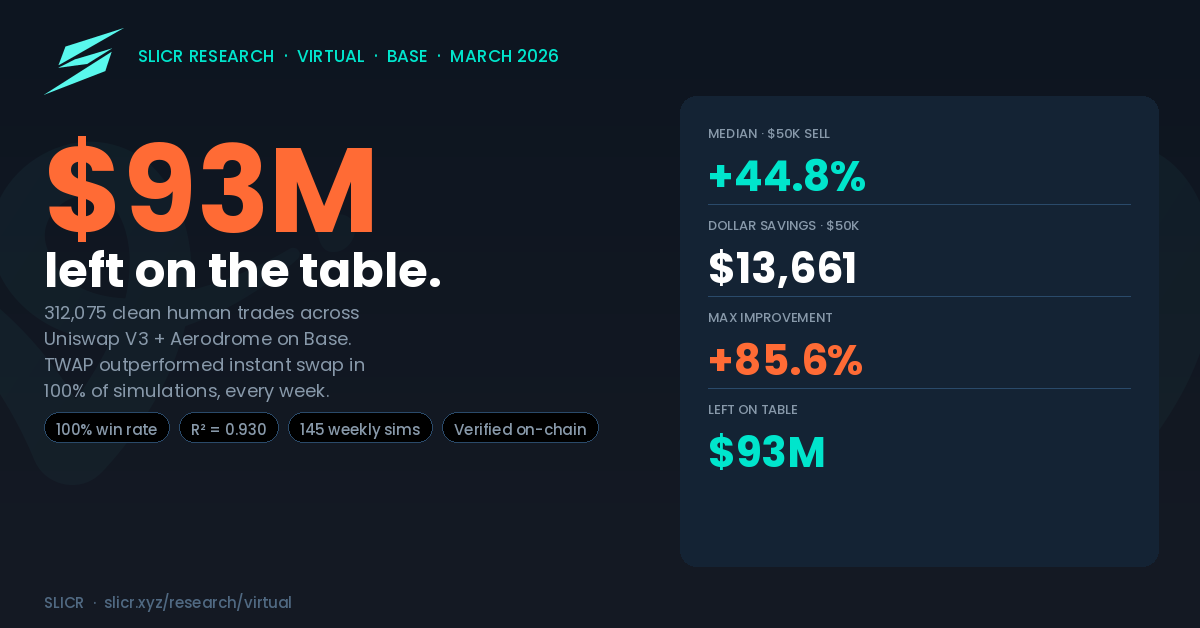
We fetched 40,906,680 on-chain transactions across five VIRTUAL/WETH pools — two on Aerodrome (0.05% and 0.3%) and three on Uniswap V3 (0.05%, 0.3%, 1%) — covering every trade from VIRTUAL's launch through March 2026. After applying nine filters to remove bot activity, MEV sandwich attacks, and dust trades, 312,075 clean human trades remained — 156,689 on Aerodrome and 155,386 on Uniswap V3.
VIRTUAL's unique role as the reserve currency of Virtuals Protocol — where every AI agent token pairs against VIRTUAL — creates structural pool perturbation that makes instant-swap timing a lottery and TWAP execution structurally superior.
Core Results
We simulated what a Slicr TWAP would have returned versus an instant swap across 145 weekly periods. TWAP outperformed instant swap in 100% of simulations — not one exception across all order sizes and durations.
| Order Size | Instant Output | TWAP 24h Output | Improvement |
|---|---|---|---|
| $5,000 | $4,700 | $4,920 | +4.7% (+$220) |
| $10,000 | $8,868 | $9,711 | +9.5% (+$843) |
| $25,000 | $18,954 | $23,376 | +23.3% (+$4,422) |
| $50,000 | $30,525 | $44,186 | +44.8% (+$13,661) |
| $100,000 | $43,937 | $81,548 | +85.6% (+$37,611) |
Median across 145 weekly simulations (72 Aerodrome + 73 Uniswap V3). 24h TWAP, 10 slices, 30 bps fee deducted.
Pool depth drives TWAP improvement (R² = 0.930)
Pool depth explains 93.0% of the variance in how much TWAP helps. Every additional $10,000 of pool liquidity reduces the median improvement by 1.73 percentage points. VIRTUAL's pool depth has declined from ~$190K median in Q4 2024 to ~$149K by Q1 2026 — the TWAP advantage is growing over time. A $50K exit that improved by 37.5% in 2024 now improves by 47.0%.
Duration barely matters
The difference between a 4h and 24h TWAP is just 0.3 percentage points. VIRTUAL's constant multi-hop flow from 30,000+ AI agent tokens means pool recovery is fast — the pool is never sitting idle between slices. If you need to exit quickly, take the 4h TWAP with confidence.
Price direction doesn't matter
The improvement is statistically indistinguishable across rising (+44.5%), flat (+45.0%), and falling (+44.8%) markets. TWAP's benefit comes from AMM mechanics — arb bots restoring the pool price between slices — not from price direction.
DEX comparison: near-identical results
Uniswap V3 and Aerodrome produce nearly identical TWAP improvements (within 0.9pp across all order sizes), reflecting that both venues experience similar pool dynamics from the same multi-hop flow. Slicr routes each slice to whichever pool offers the best price — capturing the benefit across all five pools simultaneously.
Best single case: +$41,651 (+113%)
On March 15, 2026, a $100,000 VIRTUAL sell into a thin Uniswap V3 pool ($116,702 estimated depth) — the order was 85.7% of the pool.
- Instant swap: $36,849
- Slicr 12h TWAP: $78,500
- Difference: +$41,651 (+113.0%)
Cumulative savings: ~$93M
Across 312,075 clean swaps and $987.5M in VIRTUAL trading volume since launch:
| Order bucket | Swaps | Net savings |
|---|---|---|
| <$5K | 275,591 | $23.6M |
| $5K–$10K | 24,138 | $10.3M |
| $10K–$25K | 9,528 | $17.1M |
| $25K–$50K | 1,963 | $14.9M |
| $50K–$100K | 624 | $13.1M |
| ≥$100K | 231 | $14.5M |
| Total | 312,075 | ~$93M |
855 large swaps (≥$50K) produced more left-on-table value than 275,591 small ones.
Caveats
- AMM formula is V2 constant-product — slightly overstates impact vs real V3
- Pool depth estimated from rolling swap medians (active depth, not total TVL)
- Competing sellers not modelled — figures are single-order simulations
- Multi-hop flow from AI agent trading is variable and can cut both ways
- Medians reported rather than means for robustness to model error